What Is a Private Dining Room? How Restaurants Book, Price, and Fill Them
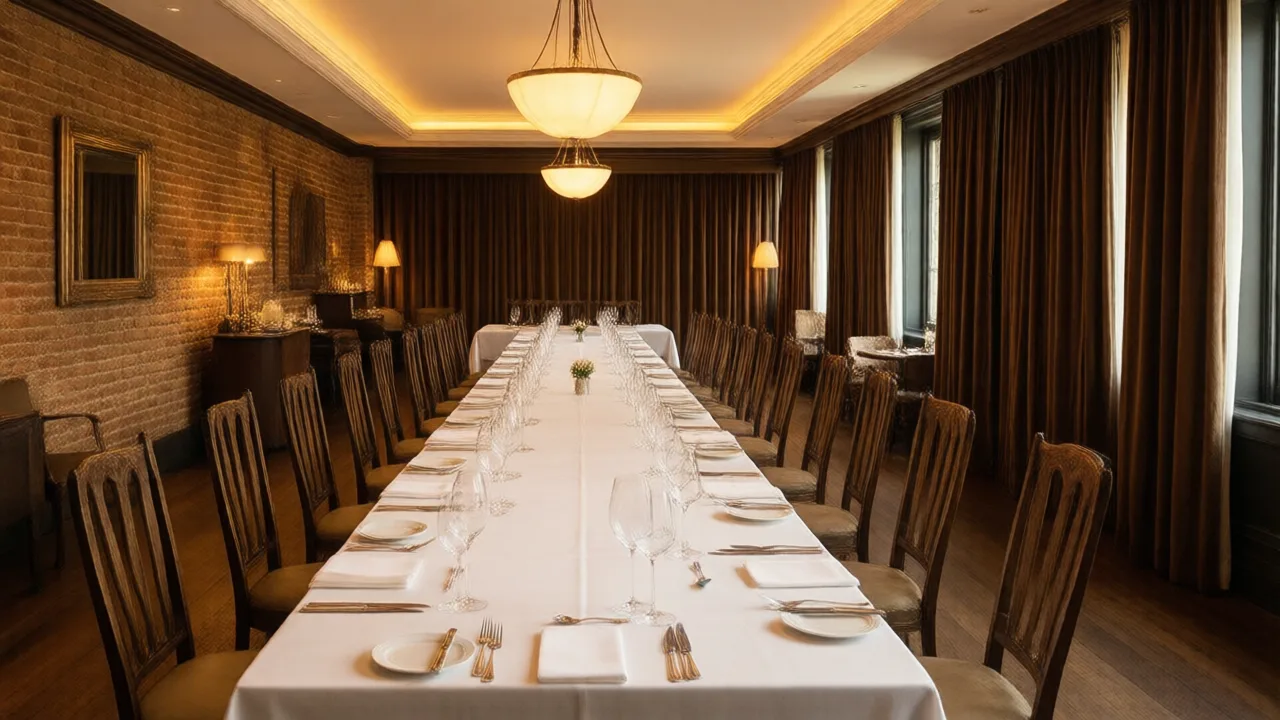
A private dining room is a fully or partially enclosed space inside a restaurant that is sold for the exclusive use of a single party for a defined block of time, priced against a food-and-beverage minimum rather than by the cover. It is where a restaurant turns a birthday, a rehearsal dinner, a board meeting, or a corporate holiday party into a guaranteed spend.
That is the clean definition. The problem is that most restaurants with a private room treat it as an afterthought — a spare space they mention when someone happens to ask, priced by instinct and booked on a sticky note. Meanwhile the room sits empty four nights out of seven while the open floor turns tables for a fraction of the margin. Private dining, done properly, is the most profitable and most predictable revenue a restaurant can sell. Here is how it actually works.
What Makes a Room "Private"
Not every large table is a private dining room, and the distinction matters for how you price and sell it. Three things separate true private dining from a big reservation on the open floor:
- Exclusivity. The party has the space to itself. No other guests are seated in it, which is exactly what a business dinner or a milestone celebration is paying for.
- Defined boundaries and a time block. Walls, a partition, glass doors, or a dedicated mezzanine — plus a start and end time the guest agrees to in advance.
- Its own commercial terms. A private room is sold on a minimum and a contract, not on à la carte willingness-to-pay one guest at a time.
Restaurants generally run one of three formats. A fully enclosed room is the premium product: four walls, a door, complete separation. A semi-private space uses partitions, curtains, or elevation to create a sense of separation without full enclosure, and sells at a lower minimum. A full buyout is the whole restaurant for one event, which is really private dining scaled to the entire footprint. The closer a space gets to full enclosure, the more a guest will pay for it, because privacy — not the food — is the thing being purchased.
Why Private Dining Is the Highest-Margin Seat in the House
Here is the number that changes how operators think about the room. On the open floor, revenue is a lottery: some tables order two courses and tap water, some order a tasting menu and a bottle of Barolo, and the average lands wherever it lands. In a private room booked on a minimum, you know the floor of your revenue before the first guest walks in.
Consider a space that seats 30. On a normal Saturday it might turn twice and generate roughly $2,400 in open-floor revenue across the night. Sold as a private room with a $3,800 food-and-beverage minimum, that same footprint produces at least $3,800 — a 58% lift — and it does so with one kitchen ticket window, one service timeline, and often a pre-set menu that dramatically simplifies the line. The margin is better not only because the revenue is higher but because a pre-negotiated menu lets the kitchen buy precisely, prep ahead, and waste almost nothing.
The predictability compounds across the calendar. A restaurant that keeps its private room dark until someone asks is leaving the single most forecastable revenue line it has on the table. A restaurant that sells it deliberately can bank a meaningful share of a month's profit before the month begins.
How Private Dining Rooms Are Priced
The heart of private dining is the food-and-beverage minimum — the guaranteed amount the party commits to spend on food and drink, before tax and service charge. If the group spends less than the minimum, the shortfall is billed as a room charge. This single mechanic is what protects the restaurant from pulling a space out of general availability only to watch the party under-order.
The right minimum is not a round number pulled from the air. It is anchored to the opportunity cost of the space — the revenue the room would have generated on the open floor during that exact slot — plus a premium for exclusivity. A useful way to see how the numbers move by daypart:
| Slot | Open-floor potential | Typical F&B minimum | Why |
|---|---|---|---|
| Weekday lunch | Low | $800–1,500 | Space is under-utilized; minimum drives incremental revenue |
| Weekday dinner | Moderate | $2,000–3,000 | Steady demand, room for a premium |
| Weekend dinner | High | $3,500–6,000 | High opportunity cost; exclusivity commands more |
| December (any night) | Peak | $5,000–10,000+ | Scarcity pricing; holiday parties book months out |
On top of the minimum, many venues layer additional charges the guest should see in writing before they sign: a service charge of 20 to 24 percent, a room-rental or set-up fee for audiovisual equipment or unusual configurations, and occasionally a flat facility fee for full buyouts. The one thing that separates professional private dining from amateur private dining is that every one of these numbers is on the contract, not sprung on the guest with the final bill. Before you set a single minimum, run the open-floor revenue the space would produce in that slot through a seating capacity calculator so your floor price is grounded in real capacity rather than a guess.
The Private Dining Booking Workflow
A private booking is not a reservation. It is a small contract, and it moves through a predictable sequence. Skip a step and you get the two failure modes every operator knows: the room held for weeks on a verbal promise that evaporates, or the party that arrives expecting a menu and an AV setup nobody wrote down.
- Inquiry. A lead comes in by phone, web form, email, or walk-in and asks about hosting an event. Speed of response here is the single biggest predictor of whether you win the booking — event planners are contacting three venues at once.
- Qualify. Capture the date, headcount, occasion, budget, and any hard requirements (dietary, AV, timing) in one structured intake, not a scattered email thread.
- Proposal. Send the minimum, the available menus, and the terms. A same-day proposal wins bookings that a three-day-later proposal loses.
- Tentative hold. Place a soft hold on the date with an expiry — 5 to 7 days is standard — so the space isn't frozen indefinitely by an undecided lead.
- Contract and deposit. The hold becomes a booking only when the signed agreement and deposit are in. Everything before this point is a maybe.
- Detailing. Lock the final menu, headcount guarantee, floor plan, timeline, and any special requests in a banquet event order the kitchen and floor can execute from.
- Confirmation and reminders. Reconfirm the guaranteed headcount 48 to 72 hours out, when most menus and staffing are finalized. Handling this the same way you would any reservation communication lifecycle — clear, scheduled, and logged — is what keeps a $5,000 booking from unraveling on a misunderstanding.
The reason to formalize this is not bureaucracy. It is that a private room booked loosely is a private room that gets double-booked, under-detailed, or lost — and any one of those mistakes on a wedding rehearsal costs you a review you will read for years.
Deposits and Cancellation: The Non-Negotiable Part
A private dining cancellation is a different animal from a no-show on the open floor. When a two-top vanishes, you lose one cover. When a 40-person holiday party cancels three days out, you lose the entire night's revenue for a space you turned other business away to hold — plus the food you ordered against a guaranteed count.
That asymmetry is why every serious private booking requires a deposit, typically 25 to 50 percent of the minimum, and a cancellation policy tied directly to it. A common, defensible structure:
- Outside 14 days: deposit fully refundable. The space can still be resold.
- 7 to 14 days: deposit partially refundable. Reselling is possible but harder.
- Inside 72 hours: deposit non-refundable, and any confirmed food costs billed. There is no time left to recover the night.
The mechanics of collecting and enforcing this are the same discipline that governs a restaurant deposit and prepayment policy on the open floor, only with more money at stake. Put the policy in the contract, take the deposit before you consider the date sold, and never let a verbal hold masquerade as a booking.
Case Study: A 90-Seat Restaurant That Turned a Dead Room Into $214,000
A 90-seat American restaurant in Nashville had a 28-seat upstairs room it used only for overflow on the busiest weekends — dark, on average, five nights a week. The owner had never assigned it a minimum, a menu, or an owner. Over one quarter they made three changes: they set daypart-based minimums ($1,500 weekday lunch up to $4,500 weekend dinner, $7,500 in December), built three fixed prix-fixe menus at different price points to simplify the kitchen, and put a single manager in charge of responding to every inquiry within two hours. They also moved every hold onto a shared booking calendar with a hard 7-day expiry and required a 40% deposit to confirm. In twelve months the room hosted 96 events, averaged a $2,230 spend, and generated roughly $214,000 in revenue that had previously been zero — at a food-cost percentage four points below the open floor, because every menu was pre-set and purchased to a guaranteed count. Not one date was double-booked, because holds and confirmed events lived in the same calendar instead of a manager's memory.
How to Keep the Room Full
Owning a private room is not the same as selling one. The venues that keep the space booked treat it as a product with its own demand engine, not a passive amenity. A few levers do most of the work:
- Make it findable. A dedicated private-events page with photos, capacities, sample menus, and an inquiry form converts far better than a phone number buried in a footer. Most private dining demand starts as a web search.
- Respond fast. Planners contact multiple venues simultaneously. A two-hour response wins bookings a two-day response never sees.
- Book the calendar backward from December. Corporate holiday parties are often booked in September and October. Open holiday inquiries by late summer and keep a waitlist for the dates that sell first.
- Turn every event into the next one. A well-run private dinner is a room full of people who each host their own events. Capture the organizer's details and follow up — repeat corporate and family bookings are the backbone of a profitable private program.
- Package around occasions. Rehearsal dinners, milestone birthdays, retirement parties, and business closings each want slightly different things. Naming and packaging them makes the room easier to sell.
Private events also sit alongside the rest of your booking operation, and they reward the same rigor. The way you protect against last-minute holes, quote realistic timelines, and communicate with guests is a continuation of your broader reservation management practice — and much of what makes a large open-floor booking succeed, covered in our guide to managing reservations for special events, applies directly to the private room.
Common Private Dining Mistakes
Most private dining money is lost in the same handful of ways:
- No minimum, or a minimum set by guesswork. If the number isn't anchored to the space's open-floor opportunity cost, it is either scaring off business or giving the room away.
- Holds with no expiry. A soft hold that never lapses freezes a revenue-generating space for an undecided lead while paying business gets turned away.
- Booking in a silo. When private holds live in a manager's inbox instead of the same calendar as everything else, double-bookings are a matter of when, not if.
- Slow inquiry response. The most common reason a venue loses a booking is not price — it is that a competitor replied first.
- No deposit or a toothless cancellation policy. Treating a big private cancellation like a single no-show is how one dropped holiday party erases a month of private revenue. The same discipline that helps you reduce no-shows on the floor matters ten times more here.
Private Dining vs. Chef's Table vs. Group Reservations
These three get conflated, and they are priced and sold differently. A group reservation is a large party seated on the open floor, ordering à la carte, with no exclusivity and no minimum — closer to a normal booking than to an event. A chef's table is a premium, fixed-inventory experience sold per seat at a set price, usually a tasting menu, with little flexibility. A private dining room sits between them: exclusive like a chef's table, flexible on menu and headcount like a group booking, and priced on a minimum rather than per cover. Knowing which product a guest actually wants — and quoting it correctly — is half the sale. For the open-floor version, our guide to group dining reservation best practices covers the party that doesn't need a room of its own.
The Bottom Line on Private Dining Rooms
So what is a private dining room? It is an exclusive-use space, sold on a food-and-beverage minimum and a signed contract, that converts an occasion into the most predictable and highest-margin revenue a restaurant can book. The definition is simple. The money is in the discipline: a minimum anchored to real opportunity cost, a booking workflow that moves inquiries to signed deposits without losing them, a cancellation policy with teeth, and a fast, deliberate effort to keep the room sold instead of dark.
A restaurant that treats its private room as a spare table will earn spare-table money from it. A restaurant that treats it as a product — priced, packaged, staffed, and sold on purpose — will find it is quietly one of the most profitable square feet in the building.
Run Private Dining Like a Product
KwickBook manages private-room holds, deposits, event minimums, and banquet details on the same calendar as your everyday reservations inside KwickOS — so a private booking never collides with the open floor and no hold is ever lost in an inbox.
Learn how KwickOS handles reservations and events →