AI Phone Reservations: When the Host Stand Can't Pick Up
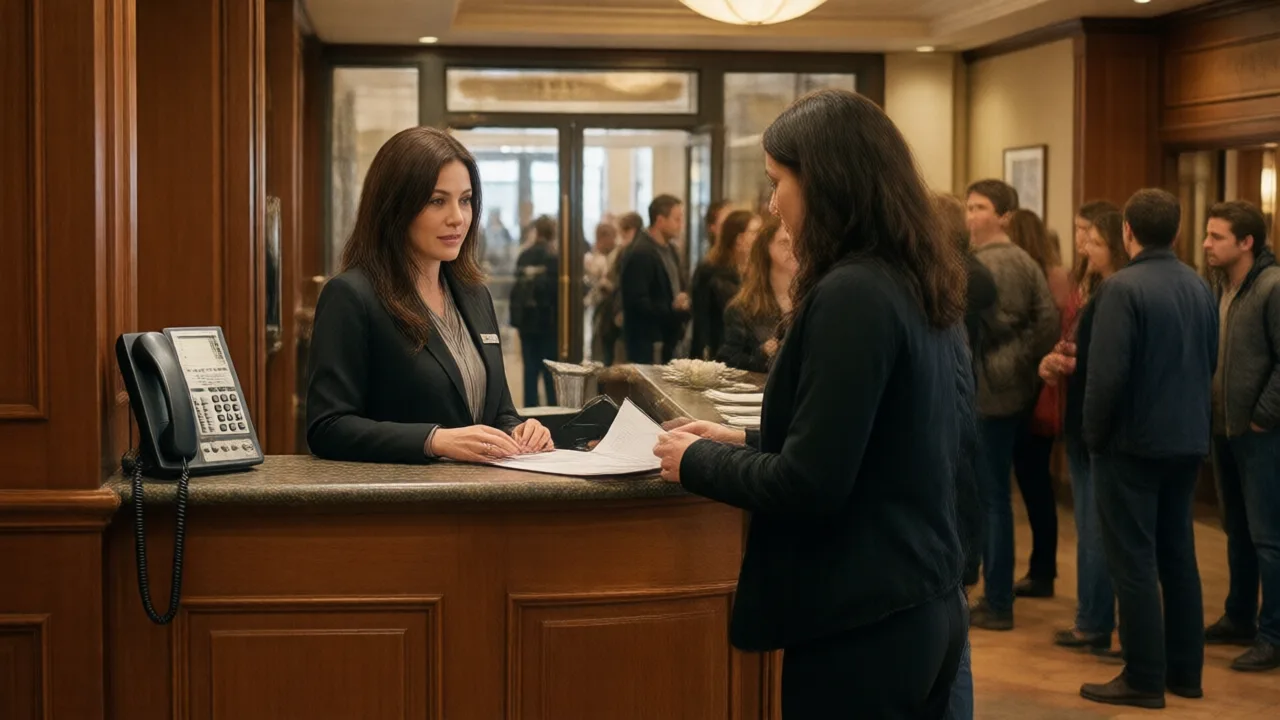
Pull your phone records for last Saturday and look at the 6:00 PM to 8:00 PM block. For most independent full-service restaurants, somewhere between a quarter and 40% of those calls were never answered. Not answered badly — never answered. The phone rang at the host stand while the host was walking a party of six to table 22, and by the time it was free the caller had hung up.
Now look at when it happens. The missed-call rate is not spread evenly across the day. It clusters into exactly two windows: the dinner rush, and the Friday and Saturday lunch period when people are deciding where to eat that night. Those are the calls with the highest booking intent in the entire week, and they are the ones your operation is structurally worst at answering.
Here is the number that turns it from an annoyance into a P&L item. Roughly half of callers who hit voicemail at a restaurant never leave a message and never ring back — they call the next place. A restaurant taking 90 inbound calls a week and missing 30% loses 27 calls. If two-thirds of those had booking intent and the average party is 2.8 people at a $54 check, that is about $2,720 of walked revenue every week, or $141,000 a year. Nothing in your P&L will ever show it, because unanswered calls do not generate a record of what they would have been worth.
Why the Host Stand Cannot Fix This
The instinctive response is to tell the host to answer the phone faster, or to add a person. Both misunderstand the problem.
The host's actual job is the room. Reading the door, working the waitlist, quoting honest waits, seating parties in an order that protects kitchen pacing, and giving the person physically standing in front of them undivided attention. The phone is a task that interrupts every one of those, and it interrupts hardest at exactly the moment the floor is most demanding.
Watch what actually happens when a host does pick up during the rush. The guest in front of the stand is put on hold socially — the host is talking to someone else while looking at them. The caller gets a rushed interaction with background noise. The waitlist stops being worked. Turn times slip because tables are not being reset in the right order. A single two-minute call during the peak costs more than the booking is worth.
Adding a dedicated phone person solves it and costs $28,000 to $38,000 a year for a role that is idle 70% of its shift. That math only works for restaurants doing serious volume, which is why almost nobody does it — and why making sure no inbound call goes unanswered became a technology problem rather than a staffing one.
What AI Phone Answering Actually Handles
Set expectations correctly and this technology is genuinely useful. Set them wrong and you will be disappointed and your guests will be irritated. The reliable, high-volume use cases are narrow:
- Taking a new reservation. Date, time, party size, name, phone number, occasion, seating preference — written directly into the book against live availability, not into a message queue.
- Changing or cancelling an existing booking. This is a surprisingly large share of inbound volume and almost pure overhead when a human does it.
- Answering the same six questions. Hours, address, parking, whether you take walk-ins, whether the kitchen can handle a gluten allergy, whether there is a patio. These represent a third of all restaurant calls.
- Adding a caller to the waitlist. Especially valuable when the book is full and the alternative is the caller simply going elsewhere.
- Taking a structured callback request. Not a voicemail — a logged request with the caller's name, number, reason, and a stated callback window.
Those categories cover roughly 70% to 80% of inbound restaurant call volume. That is the realistic prize: not replacing the phone experience, but catching the three-quarters of it that is routine and currently going unanswered during peak hours.
The one requirement that makes or breaks it: the answering layer must be able to see and write to your actual reservation book in real time. A system that takes a request and emails it to the host stand has not solved anything — it has added a step. The guest needs to hear "That is booked, you will get a text confirmation in a moment" while still on the call, which means live availability, live table assignment, and a write-back into the same book the host is looking at. Restaurants running an AI reservation layer on top of a connected book get materially different results from those bolting one onto a disconnected phone system.
Where It Must Hand Off
The handoff rules matter more than the answering capability. A system that tries to handle everything will damage guest relationships faster than a ringing phone ever did. Five triggers should route to a person immediately, with context attached so the guest never has to repeat themselves:
- Any hint of dissatisfaction. A complaint routed to a human within seconds is recoverable. A complaint processed by an automated system generates a review that mentions the automated system.
- Large parties. Above your threshold — usually eight or ten — bookings involve room configuration, menu discussion, and deposit terms. Those are negotiations, not transactions.
- Anything involving money. Deposits, refunds, gift cards, disputed charges, event balances. Always a person.
- Two failed attempts to understand. If the system has not parsed the request twice, it will not parse it on the third try. Hand off before the caller gets frustrated rather than after.
- Any explicit request for a human. Immediately, with no friction and no attempt to resolve first. This single rule does more for perception than any amount of voice tuning.
Outside service hours the correct handoff is not an open-ended voicemail box. It is a logged callback request with a stated response time — "Someone will call you back before 11 AM tomorrow" — and then somebody actually doing it. A callback promise that is not kept is worse than never having answered.
The Guest Experience Question
Operators worry about this more than guests do, and the reason is that they are running the wrong comparison. The question is not "AI versus my best host on a quiet Tuesday." It is "AI versus a phone that rings twelve times and goes to a voicemail box nobody checks until Monday."
Against that comparison, callers respond well, but only when four conditions hold:
- It answers in under two rings. Speed is most of the perceived quality.
- It states plainly what it can do. "I can book, change, or cancel a table, or get you to someone on the floor" beats a warm but vague greeting.
- The task completes in under 90 seconds. Beyond that, callers start looking for the exit regardless of how the conversation is going.
- A human is one sentence away. Knowing the escape hatch exists is what makes people willing to use the system at all.
What guests genuinely dislike is unchanged from thirty years of phone trees: long menus, being asked to repeat themselves, and any system that refuses to connect them to a person. Those are implementation failures, not technology failures, and they are avoidable.
Example scenario: 62 Recovered Bookings a Month at a 110-Seat Neighbourhood Restaurant
Illustrative scenario — a composite example built to show how the numbers work. It does not describe a real business or customer.
A 110-seat restaurant in Denver pulled three months of call data and found 41% of inbound calls between 5:30 PM and 8:30 PM went unanswered, against 9% outside those hours. Total missed calls averaged 118 a month. They added an AI answering layer connected directly to their reservation book, with handoff rules for complaints, parties above eight, and anything involving money, plus an explicit "let me get someone" trigger on any request for a human. In the first full month the system answered 104 of 112 inbound calls during peak windows and completed 71 of them without human involvement — 44 new bookings, 19 changes or cancellations, and 8 information requests. Twenty-three calls were handed to staff, of which four were complaints routed within 15 seconds. The host team reported the more valuable change was not the recovered bookings but that the phone stopped interrupting the door. Average quoted wait time accuracy improved noticeably because the host was actually watching the floor. Net recovered bookings settled at about 62 a month, roughly $9,400 in monthly revenue.
Setting It Up Without Sounding Like a Robot
The failure mode here is treating configuration as a checkbox. A week of preparation determines whether this works.
- Measure first. Pull 30 days of call data: total inbound, answered, missed, by hour and day. Without a baseline you will never know whether it worked, and the baseline is usually worse than anyone in the building believes.
- Write the answers to your twenty most common questions. Actual sentences, in your restaurant's voice, not bullet points. Hours, parking, dress, allergens, walk-in policy, patio, kids, dogs, private dining, gift cards. This document is the single biggest determinant of quality.
- Connect it to the live book. Read and write, real availability, real table assignment. If the integration is one-way, stop and fix that before going live.
- Define handoff rules explicitly. The five triggers above, plus anything specific to your operation. Write them down; do not leave them to defaults.
- Set hours of operation for the system. Many restaurants get the best results running it only during peak service, when the miss rate is worst, and letting humans answer everything else.
- Test with real calls before launch. Have staff and a few friendly regulars call with awkward requests — a party of eleven, a peanut allergy, a wheelchair question, a complaint about last Friday. Fix what breaks.
- Review transcripts weekly for the first month. Every failed call is a gap in your answer document. This is where the quality actually comes from.
How It Fits the Rest of the Booking Stack
Phone answering is one intake channel among several, and it should not be treated as a standalone product. The guest who calls at 6:40 PM, the guest who books through your website widget at 11:00 PM, and the guest who walks in at 7:15 all need to land in the same book, against the same availability, with the same pacing rules applied.
When they do not, you get the classic failure: the phone books a table that the online widget also just sold. Getting the online booking widget and the phone layer to quote the same availability is the baseline requirement, not an advanced feature.
The second connection worth making is to the waitlist. A caller told "we are fully booked tonight" is a lost cover. A caller added to the waitlist and texted at 7:20 PM when a table frees up is a recovered one, and the decision about when to offer a booking versus a waitlist slot is the same judgment your host makes at the door. Feeding phone traffic into that system rather than turning it away is often worth more than the new bookings the system takes.
Third, the guest record. Every answered call should enrich the profile: the allergy mentioned, the anniversary, the seating preference, the fact that this is the caller's fourth booking this quarter. That information is what makes the next visit feel personal, and it is exactly what gets lost when calls go to voicemail. It also feeds back into floor performance — knowing a party of four has a 7:00 PM booking and a stated 90-minute window helps the host manage turn times without ever making a guest feel rushed.
What to Measure After Launch
- Answer rate during peak windows. The headline number. Should move from somewhere in the 60s to above 95% within the first month.
- Completion rate without handoff. Healthy is 60% to 75%. Much lower means your answer document has gaps; much higher may mean handoff rules are too tight.
- Bookings created by channel. Track phone bookings separately so you can see the recovered volume rather than assuming it.
- Handoff response time. How long a transferred caller waits for a human. If this exceeds 30 seconds during service, the handoff rules are creating a worse experience than they prevent.
- Complaint routing time. Should be under 20 seconds, every time, with no exceptions.
The Honest Summary
AI phone answering is not a hospitality upgrade. Nobody has ever chosen a restaurant because its phone system was clever. What it is, precisely, is a fix for a structural gap: the two hours a day when your phone is busiest and your host is least able to reach it.
Judge it on that basis. If a quarter of your peak-hour calls currently go unanswered, an answering layer connected to a live book will recover most of them, hand the difficult ones to a person within seconds, and give your host back the attention the room deserves. If your phone is already answered within two rings at 7:00 PM on a Saturday, you do not need it — and you should tell the rest of us how you staffed that.
Stop Losing Bookings to a Ringing Phone
KwickBook keeps the book, the waitlist, and the guest record in one place inside KwickOS, so an AI answering layer can quote real availability and write real reservations instead of taking messages. Every call becomes a booking, a change, or a logged follow-up.
See How KwickOS Handles Call Bookings →